Tuesday, May 25, 2010

What is the VFR?


The new Honda VFR 1200 has presented some journalists with a problem they encounter occasionally; what category does this bike fall into? Is it a sportbike, a sport-tourer, or something that defies categorization? There is no universally recognized guide for naming motorcycle categories. There may be some consensus among the journalists but it is a shifting sand. The world of sporting motorcycles is so broad that the term sportbike is not very helpful. Do you then call a Yamaha R1 a super sport, a super bike or a hyper sport?

There is a name that has been used in many publications for bikes that fall between pure sport and sport-tour. It is a name long used in the world of sporting automobiles and that name is Grand Touring, or in Italian: Gran Turismo. A Ferrari that makes sacrifices in performance in favor of comfort and luxury is a prime example of a GT automobile. It may have two seats and a stomping 12-cylinder engine but it was never aimed at the race track and does not qualify as a true sports-car. GT cars tend to be a little larger and a little heavier. There are many motorcycles that follow that same formula.


                                                            Ferrari Daytona


As the spectrum of motorcycles became more diverse and specialized during the 70's and 80's, the high-performance end of the spectrum divided into those bikes that were destined to be used as a platform for production-bike road racers and those that were somewhat performance compromised to make them more comfortable and practical as a street bike. One of the early examples that comes to mind is the BMW R90 RS. The RS was one of the first bikes to come standard with an aerodynamic fairing and windscreen. It was built for speed on the Autobahn but not on the race track.

                                                                  BMW R100RS

 The original Honda Interceptor saw action at the top levels of racing but the descendant VFR took a divergent path as Honda went racing with more focused machines like the RC30. Joining bikes like the Yamaha FJ and Ducati Paso, the VFR became a classic GT. Fast, but not the fastest. Light, but not the lightest. Sporty, but not the ultimate weapon for carving up a set of curves. What you got in return was blend of comfort and speed, practicality and excitement.


 The GT motorcycle genre includes far too many bikes to list but came into full maturity in the 1990's with bikes like the Kawasaki ZX11, Suzuki Hayabusa and Honda Blackbird. Still, the VFR remained in the lineup squarely under the GT tent.

That the new VFR should cause some confusion as to how to classify it would seem to deny the historical validity of the GT category. If the VFR is not obviously a sportbike and not obviously a sport-touring bike, then it should very naturally fall into the GT camp. So what if is has a shaft drive? So did the RS. So what if it weighs more than some other 1200s? It has moderately low bars and a narrow waistline. It's not a race bike. It doesn't come with saddle bags. Although it could certainly be used for sport touring, (so could a CBR1000RR) it is not a sport-touring bike in the classic sense. If it came standard with hard bags (as the Triumph Sprint now does) we might be tempted. Some might also be tempted to borrow the non-specific term of "crossover." The new Multistrada crosses over so many categories that it merits much more confusion than the relatively straightforward VFR. What it is should be fairly obvious. It's fast, nimble, practical and comfortable. It's a GT.

Sunday, March 29, 2009

Ice Racing Comes to Wenatchee

My wife and I went to the ice races last night. It was a pretty good show. The course is very small so they spend most of their time in the corners. Two racers ran straight into the wall early on and one guy was doubled over in pain for a long time but finally got up and walked off. The announcer had some bogus information and kept saying the bikes had 4-cylinder engines. Once he said they were "trials bikes with crotch rocket motors." They looked like typical speedway bikes to me with single-cylinder motors. Probably Westlakes or Jawas or whatever they use now. The quad races were fun too. My favorite were the 2 little kids ages 3 and 4 on tiny little quads! The new event center is pretty cool (literally - we should have taken warmer jackets). Almost any seat would give a decent view of the ice and the sound system is quite good so you can actually understand what the announcer is saying. An evening well spent.

Tuesday, February 10, 2009

John Britten Documentary Video

I hold as my considered opinion that John Britten is as close as we have come to a Leonardo DaVinci in modern times. He could have gone down in history as an innovator in almost any field but fortunately for us he chose to build a motorcycle. John has become one of my lifetime heroes. He was an artist, a visionary, a mechanical genius, a god among backyard mechanics, and perhaps delightfully, just a bit of an insane lunatic.

When the Guggenheim Museum moved its Art of the Motorcycle Exhibit from New York to Las Vegas, I was able to attend and experience one of the truly great motorcycle collections ever assembled. For me, the highlight was to finally see a Britten motorcycle in the flesh. There has never been anything like it and possibly never will be. The cutting-edge technical innovations that permeate that bike from one end to the other would be impressive enough without the shoestring budget and isolation under which it was wrought. If that wasn't enough, the artistic genius in John gave us a truly stunning work of art. This is the spirit of Form Follows Function at its highest level. Not enough yet? The bike actually worked, and worked so well it beat the best on the racetrack.

I have a large framed print of the Britten hanging on the wall in my office. I have the memory of tracing its sensuous curves with my eyes in three dimensions. Sadly, that is all that is left of the enchanted Britten workshop. When I heard in 1995 that John was dead from cancer I went into a minor state of depression. He was born in 1950, same as me. My hero was gone, leaving us to wonder what he might have accomplished in time. I mourn his death to this day.

I have just found a documentary film that can be viewed on the Internet. It is given in five short segments that chronicle John's amazing life and motorcycling triumph. It only briefly touches on some of the ground-breaking techniques John used to solve his engineering problems. The deeper you delve into this fantastic machine the more impressive it becomes. Watch these videos and it may inspire you to learn more about John and his bike. Do some web searches or buy a book. He may become your hero too.

to link to the videos click here

Sunday, July 13, 2008

Duke vs. Shiver

Yesterday I found myself wandering aimlessly around the metro area west of the Cascades. Quite by accident I just happen to pass by bike shops in both Lynnwood and Seattle. Blinded by the intense sun and parched to near delirium, I mistook the parking lot of Lynnwood Motoplex for highway 99 and lurched to a stop just before ramming the curb. Lost and confused I walked inside and blurted out: "Could I take the KTM 690 Duke out for a test ride?" Well, I had to say something. O.K. Test riding motorcycles is one of favorite things to do. It was just a knee-jerk reaction.


Dagnab it if that little black & white Duke didn't catch my eye at last winter's bike show. The original Duke has always been on my hot list but this new one really looks cool. Highway 99 and the adjacent residential streets aren't the best place to put a hooligan bike through its paces but a short loop around the neighborhood and a buzz through an empty school parking lot gave me a feel for what the Duke might be like to live with, if not really discovering it's ultimate capabilities. I'm sure they are dangerously fantastic. The Duke ride is not altogether different from what I get on my DR650, at least ergonomically. The seat is wider/better and it has a more substantial, flex-free chassis and vastly better suspenders. The Duke feels expensive and is, at about $9000. KTM is proud of the power output of this little single and it plainly has more beans than my piped and jetted DR. In fact, in darting around at speeds below 60, I thought that its power fell somewhere in the middle between the DR and my Multistrada 1000. Being a single, this sensation would surely change if I had more open spaces to explore the upper range of it's speed where the bigger bike should walk off and leave it. But the Duke is not made to spend much time at high speed. It seeks the tight corner where it can be tossed to and fro, zipping in and out like a pesky gnat. It would be sacrilege to own a Duke and not develop some skill for wheelies and stopees. Maybe I'm getting too old for such antics but I know I could have fun on a Duke even if I didn't manage to leave a trail of black scallop marks on the road. The little Duke sounds throaty and good if you have any affinity for singles, and the Robo-bike styling would attract attention wherever it goes. But then, there are some types of attention I don't need. This thing could get me into trouble.

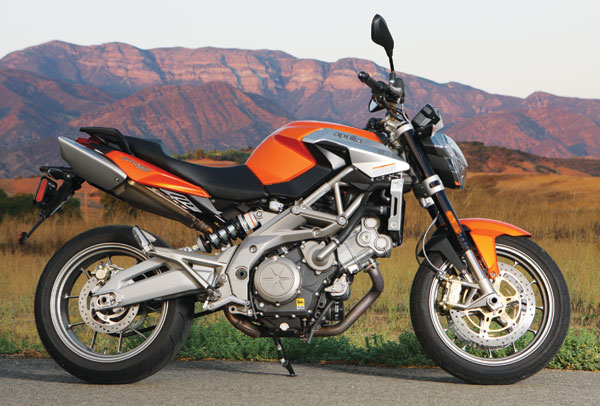
How I ended up on Aurora Avenue I'm not sure but I managed to swoop into the Aprilia / Moto Guzzi dealer for directions. Not sure of how else to help, they sent me out on a Aprilia Shiver to get my bearings. This bike looks fantastic as an Italian bike truly should. The 90-degree V-twin could sound like a Ducati but instead has a different tone; more staccato and not at all subdued for a stock exhaust. The first thing I noticed was the clutch engagement very close to the hand grip. The next thing was... Whooa! This thing wants to jump out of the gate. You want immediate action? Just crack the throttle and the crankshaft is making the leap to torque mode like it's already happened. I've never experienced such instantaneous throttle response. As the bike's speed builds, the Shiver provides a nice linear surge of power like you would expect from a modern 4-valve 750 twin. Nothing spectacular like the initial pop, but good and peppy. Like all bikes these days, the fueling is lean and could probably be made smoother in on/off throttle transitions with some remapping, but the experience is definitely sporty good fun with not much to complain about. When I returned, the salesman reminded me that this bike has "fly-by-wire" throttle and comes with 3 switch settings - sport, touring, and rain. I had only sampled sport. Momma mia! Bring it on. This bike can pop small power wheelies easier than the Duke and that is saying something.


In comparing the two bikes, I noticed they are about the same price. Hmm. The Shiver is a real motorcycle and would be a lot more versatile than the Duke, but then I sure wouldn't buy a Duke for versatility. It's a sharp and pointy fun-stick. Not that I wouldn't want to use it for short commutes and errand-running, but no ride to town on a Duke could be mundane. Yank those handlebars and poke that corner in the eye! Still, the Shiver is tempting. It is everything my cherished old Suzuki SV was and a whole lot more. Not insignificantly, it sounds much better than the Duke. The Shiver's fatal flaw for me might be that it is too much like the Multistrada that I plan to keep. A gorgeous and rambunctious Italian but with less torque, comfort and wind protection than the Multi. Fortunately, I'm not in a hurry to choose my next bike cuz it won't be easy.

Friday, April 18, 2008

DR Hop Up

I am generally happy with the power characteristics of my bikes, but the Suzuki DR 650 is so mildly tuned and docile that I began to think it might be worth the expense to liven up the motor a bit. The big DR is much heavier than the smaller DRs and is somewhat hampered in the dirt by this weight. Mounting semi-knobby tires helps but it remains more impressive on pavement than in the dirt. While it has gobs of torque for off-road use, you can never have too much power on the street.

I ordered an FMF slip-on muffler from Jessie, the DR guru at kientech.com. His web site shows pictures of how to open up the air box for better breathing on the intake side. I simplified the procedure by using a hole saw to make a couple of large round holes in the box. I then rode down to Mike Kirkpatrick's Pro Tec Dyno to get the carburetion dialed in. This was my first experience with a motorcycle dyno and it is pretty impressive. Since all bikes come from the factory with lean jetting these days, opening up the breathing at both ends only makes things much worse and the carb must be re-jetted for maximum power and longevity of the motor.

What I didn't realize about modern dyno machines is that they have a sniffer that goes down the exhaust pipe to read the actual fuel-air ratio all the way up through the RPM range. The initial dyno run revealed lean burn that was off the chart. Mike's been tuning bikes as a hobby for decades and has such a feel for it that he picked the correct jet the first time on my bike. He says he got lucky but he obviously knows what he's doing. A couple of other tweaks to the carb and it was back on the dyno to check the result. Both he and I knew right away that this run was much different. Now the docile DR was really making power and spinning the dyno drum at a ferocious clip. The printout revealed a 7 HP increase and a truck-load of additional torque - especially in the mid RPM range - and my fuel-air mixture was now right where it should be.

I found it hard to explore all this new power in the city, as opening the throttle half way quickly puts the speed into the bad-ticket zone. Once on some twisty country roads it was plain that the old DR was now a bit of a beast. Whacking open the throttle makes a lot more noise with the aftermarket can, but there is also some serious muscle to go with it. It feels like it wants to tear the knobs off the tires. At first I was tempted to say that the 650 now felt like an 800 but that is not quite right. Before, it was a 650 with a pillow jammed into both ends. Now it feels like a hot 650 - at least by comparison. It really feels like a 650 version of my KTM 450 - still torquey and tractable but much more athletic than the dumbed-down stocker. I would say that an increase in power in the same bike pays out dividends in fun by a factor of two. A 20% increase in power yields a 40% increase in fun - and fun is what it's all about. I now have what amounts to a new bike for only a few hundred dollars. Money well spent.

There is another reason I went for the aftermarket pipe - weight, or lack thereof. My bike lost 7.8 pounds. I had my doubts that I would really notice the weight reduction while riding but I do. While roosting up the dirt road that links Cashmere's sewage treatment plant with Monitor's orchards, I felt the bike was handling better. It's not just the weight but where the weight is located on the bike that can make a difference. Sport bike designers are all aflutter over mass centralization these days. On the DR, those extra pounds were hanging high and to the rear - far from the center of mass - like an eight pound pan handle. When the bike wanted to twitch to the left, that old muffler wasn't done swinging to the right. The loss of weight can only benefit acceleration, deceleration and every other kind of motion. Money even better spent.

Friday, April 11, 2008

Ducati People Unite

When I bought my first Ducati in 1992, I was unaware of any other Ducatis in the Wenatchee area. Eventually my brother bought a 900ss and it was my belief that we had the only two in town. Then a yellow 748 appeared on the scene but before I could meet the owner I heard of a terrible accident. Over the years I have seen more Ducs running around, mostly Monsters. It has been my hope that we might find a way to get together as a group just to share the Ducati experience. Last Fall I posted a notice on Craig's List -- Wenatchee having its own section for motorcycle want ads. I got three responses right off the bat. I tried again this Spring and got several more. I now have a list of a dozen or so, most of them in the Wenatchee area.

Last weekend, I was able to get four of us together for our first group ride. We had a red 999, a yellow 748, a 620 Monster Dark, and my beloved red Multistrada. The day was cool but brilliantly sunny. We met in front of the old K Mart store and headed up the Cashmere valley. We took as many back roads as possible, starting with Chatam Hill, Lower Sunnyslope, and Sleepy Hollow roads. I love how my bike wants to leap into the air over the big hoops on Sleepy Hollow. After crossing the old wooden bridge west of Monitor, we were on the highway long enough to bypass Cashmere. Taking the third bridge to connect with the old Sunset Highway, we noticed our Monster rider was not with us. The other two riders turned back to find him while I waited briefly. I mistakenly thought I saw them head back into Cashmere and went to find them. After searching the likely places and missing them parked under the bridge, I decide to head to our next stop at the Timberline Motel in Peshastin. The owners have turned the little old wooden gas station into a motorcycle repair shop and Lizi counts a shiny red 900ss among her many bikes. The other riders were already there, as Seth was getting make-shift repair done to his bike's shift lever.

Unable to persuade Lizi to break away from work and join us on the ride, we headed up the Peshastin North Road toward Chumstick Valley. All these back roads are pure joy on a motorcycle. For the most part, the pavement was clean and dry. The Chumstick gets progressively better the further up you go until you switch back up over Beaver Hill. The far side of the hill is blessed with the most luscious set of tight curves. They are always a blast, whether running up or down the hill, but the lighter and more nimble the bike, the better. Stopping briefly in Plain to catch our breath, we headed out on the Chewawa Loop Road. This road snakes through the forest, undulating up and down. The pavement is not smooth and the vestiges of winter were evident in the debris and trickles of cold water running over the road in places. Not a fast road but a pleasure just the same.

Finding ourselves on the Lake Wenatchee highway, it was time to open the throttle for a fast run back to Highway 2. Seeing the road open up, the 4-valve bikes pulled the trigger and blasted past me like I was standing still. The open cans on the 999 sounded like a Howitzer in my left ear. It all ended too soon at Coles Corner but we were hungry and swung into the '59er Diner for some hot food and a little flirting with "Flo." (They're all named Flo there)

So, the Ducati contingent has met and rode and lived to tell about it. The weather is finally starting to warm and we hope to make this ride the first of many. It would be fun to get 6 or 8 Italian Stallions running together.

Wednesday, March 5, 2008

Definition of Spring

I've never liked the official definition of the "first day of spring." I'm always anxious for it to come as early as possible so I can get outside and do things, such as ride, ride, ride. That really depends on the weather, not the calendar. To solve this problem I have developed my own definition, which is: The first five consecutive days after February 15th when the temperature does not drop below freezing. This year, that day came on Feb. 24. The 24th was the first of the five days. With this method you can't know when Spring actually begins until the end of the five day period, but you can look back with fondness and remember what you did during those first glorious days of Spring.